the Bastille
The Three Musketeersthe Bastille is the most feared prison in the political world surrounding the novel’s characters, but its importance exceeds its physical walls. It stands for the arbitrary reach of royal and ministerial power: a threat capable of silencing an ordinary man, coloring military disputes with fear, and making arrest itself a weapon of investigation. Even when the narrative does not place the reader inside its cells, the Bastille remains present as an imagined destination whose power operates through anticipation.
A Prison Made Present by Fear
The Bastille first appears through the narrator’s account of publication and censorship. The Memoirs of d'Artagnan the younger, which provide the ostensible source for the story, were printed at Amsterdam because writers of the period could not tell the truth without risking a more or less lengthy residence in the Bastille. The prison therefore enters before the principal adventures as a condition surrounding historical speech. It marks the point at which political authority can punish not only deeds but also narration itself, making the act of recording the past a hazardous form of conduct.
That same fear circulates among ordinary people. The host at the Jolly Miller Inn warns d'Artagnan the younger’s new acquaintance that the young Gascon is no devil, but has spoken defiantly of the insult he has suffered and invoked M. de Treville. When d'Artagnan the younger later reads the threat against Monsieur Bonacieux, the frightened husband confesses that he is not a fighting man and fears the Bastille. His terror reveals the prison’s social function: it need not appear in order to control behavior. The possibility of confinement is enough to make a civilian abandon resistance and seek protection from someone more accustomed to the sword.
The Bastille and the Machinery of Authority
The prison belongs to a broader environment of overlapping conflicts. In 1625, nobles fight one another, Louis XIII struggles with Cardinal Richelieu, Spain makes war against the king, and robbers, mendicants, French Calvinists, wolves, and other scoundrels threaten the public order. Citizens readily take up arms against many of these dangers, yet the cardinal and Spain are treated differently. This hierarchy of permissible enemies helps explain why the Bastille is so formidable: it is not merely a defensive fortress but an instrument of a political order that distinguishes between disorder to be fought and authority that must be obeyed.
The military establishment is also shaped by this coercive atmosphere. M. de Treville’s name is spoken frequently by soldiers and citizens, while Father Joseph, the Gray Eminence of Cardinal Richelieu, is mentioned only in subdued voices because of the terror he inspires. Treville commands the king’s Musketeers, whose devotion to Louis XIII is described as nearly fanatical, while Richelieu maintains a rival corps of Cardinal’s Guards. The king and the cardinal publicly condemn duels and brawls even as they privately encourage competition between their swordsmen. Against this background, the Bastille represents the bureaucratic counterpart to the sword: where armed retainers contest power in public, imprisonment threatens those who cannot contest it on equal terms.
Surveillance, Arrest, and the Mousetrap
The novel contrasts the Bastille’s generalized terror with a more immediate technique of secret detention. When the apartment of Monsieur Bonacieux is transformed into a mousetrap, Cardinal Richelieu’s agents hide in the first room, admit visitors, close the door, and arrest those who enter. Within two or three days, such a method can place nearly all the habitués of a house in custody. The procedure converts an ordinary domestic space into an extension of the prison system, showing that confinement begins not at the cell door but with controlled access, concealed observers, and the manipulation of trust.
D'Artagnan the younger avoids this detention because a separate passage leads to the first floor where he lodges. He turns his chamber into an observatory, watches visitors being caught from his windows, removes a plank from the floor, and listens through the remaining ceiling to the interrogations below. The agents repeatedly ask whether Madame Bonacieux has sent anything to her husband or anyone else, whether Monsieur Bonacieux has sent anything to his wife, and whether either has spoken of the matter. The arrangement reverses the usual direction of prison surveillance: the authorities interrogate those below, while d'Artagnan the younger secretly observes and hears the investigators. His deduction that they are seeking information about the Duke of Buckingham’s possible meeting with the queen demonstrates how information, rather than physical violence alone, drives the machinery of confinement.
Royal Justice and Political Discretion
The Bastille’s menace also shadows formal claims to justice. When Cardinal Richelieu presses a case against one of M. de Treville’s men, Treville insists that judges should decide it, while the king commands that the case be sent before the judges because judging is their business. Yet Treville immediately warns that, in such unfortunate times, even the purest life and the most incontestable virtue cannot protect a man from infamy and persecution. The exchange preserves the language of lawful procedure while exposing the insecurity beneath it. A judicial process may exist, but its initiation and atmosphere remain vulnerable to police power and political pressure.
The same structure appears when the chancellor approaches Anne of Austria to seize a paper at the king’s command. The queen refuses and would rather die, while the chancellor advances with the grim determination of an executioner entering a torture chamber. No cell is shown, but the scene carries the logic of imprisonment into the royal chamber: authority treats the queen’s body and private papers as objects that can be searched, and resistance itself becomes perilous. The Bastille thus functions as the imagined endpoint of a continuum extending from surveillance and interrogation to confiscation, arrest, and confinement.
The Prison as a Recurring Political Horizon
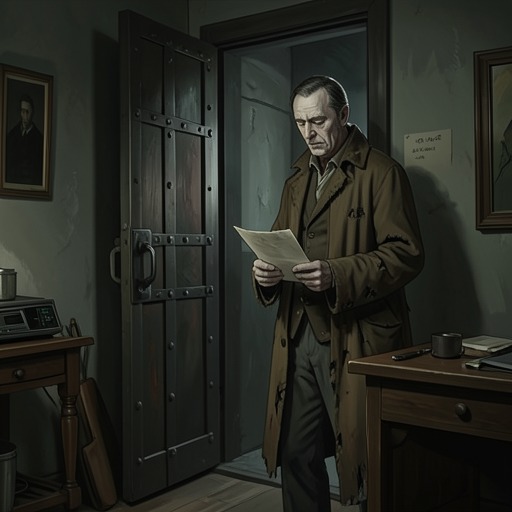
The later imprisonment of Milady the English spy clarifies the difference between confinement as a place and confinement as a contest of wills. She is brought through two arched gateways into a dark square court, where a young officer receives her with formal politeness. His silver whistle summons the men who unharness the smoking horses and secure the carriage; he then escorts her through a vaulted passage to a stone staircase and a massive locked door. The chamber is furnished so that it might belong either to a prisoner or a free person, but barred windows and outside bolts settle the question. Here imprisonment is made visible through thresholds, keys, bars, and bolts—the physical grammar that the Bastille embodies in the public imagination.
Milady immediately treats the prison as an environment to be studied and manipulated. After hearing that supper will be brought, she decides to examine the characters of the men guarding her. When light appears beneath the door, she arranges her body and clothing to seem vulnerable: she throws herself into a chair, leaves her hair disheveled, exposes part of her bosom beneath crumpled lace, and places one hand over her heart. The performance is designed for the jailers, especially Felton, and turns surveillance into a reciprocal exchange. The prisoner is watched, but she also studies the watchers and attempts to govern what they see.
When Felton is removed, the marines are withdrawn, and Lord de Winter becomes more suspicious, Milady understands that the immediate conditions of observation have changed. Left alone, she rises from the bed she had kept in order to appear seriously wounded. A plank has been nailed over the grating because Lord de Winter fears that she might corrupt her guards through that opening. The blocked aperture and the fortified door testify to a system learning from her previous performances. Yet the loss of observers also gives her freedom to abandon the pose: she crosses the chamber with the fury of a captive animal and turns from the appearance of self-destruction toward the thought of killing Lord de Winter. Confinement restricts her movements, but it does not extinguish her agency; it instead intensifies the struggle over access, appearance, and information.
Narrative and Historical Significance
The Bastille is significant because it joins literary production, private fear, military rivalry, police investigation, and royal justice within one image of power. It is invoked in the preface as the price of inconvenient truth, feared by Monsieur Bonacieux as the punishment awaiting a helpless civilian, and echoed by the mousetrap as a portable technology of secret arrest. Its institutional presence is therefore both concrete and atmospheric. The prison does not need to dominate every scene to shape conduct; characters calculate what they may say, whom they may trust, and whether they dare to move because the possibility of state confinement is already embedded in their world.
At the same time, the prison’s authority is never presented as perfectly secure. D'Artagnan the younger escapes the mousetrap’s intended field of detention by using the separate passage to his lodging and converts his room into a counter-surveillance post. Milady turns barred windows, locked doors, guards, and official suspicion into materials for deception. These reversals do not abolish coercive power, but they reveal its dependence on spaces, routines, and information that can be observed, redirected, or exploited. the Bastille consequently stands as both the emblem of disciplined submission and the measure against which the novel’s acts of audacity define themselves.